California Consumer Protection Act in 2026: The Privacy Checks Website Teams Actually Need
A useful guide to california consumer protection act should help readers understand both the rule and the behavior behind the rule. That is where consent topics become genuinely practical instead of sounding like recycled compliance copy.
The practical review for california consumer protection act starts when you look past the banner copy and test the live behavior. That is usually where teams find the real gaps: tags firing too early, weak refusal flows, and settings that drift after routine site changes.
review the California privacy obligations your website actually triggers, then test whether the site, trackers, and rights workflow behave the way the policy says they do.
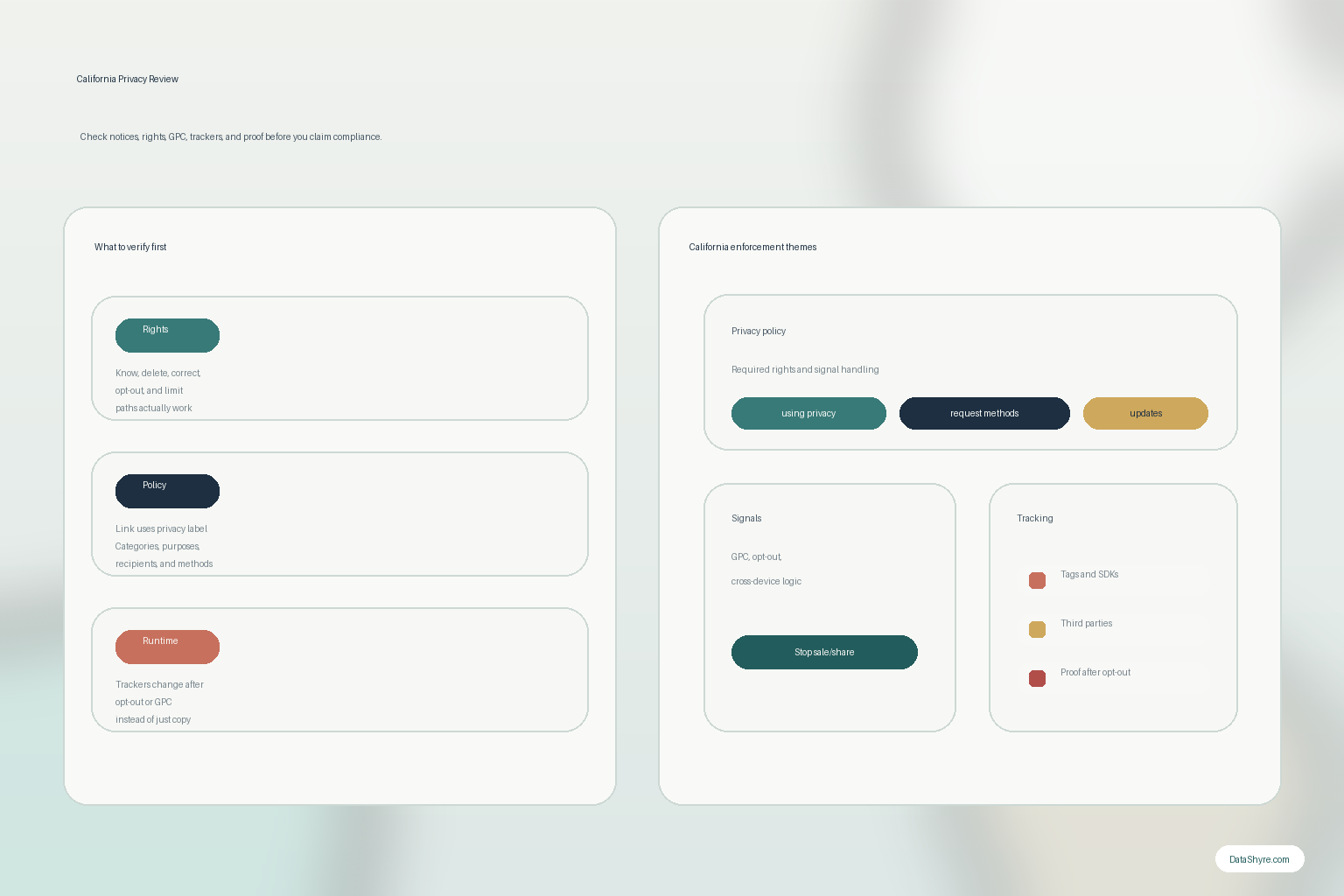
For website teams, that usually means the current CCPA stack and the rules around disclosures, rights, opt-out handling, and online tracking. California’s official CCPA materials still say consumers can ask businesses to disclose, delete, correct, and limit certain uses of personal information, and can direct businesses to stop selling or sharing personal information. The CPPA’s current notices guidance still says the privacy policy must be posted through a link “using the word privacy“ and must explain how an opt-out preference signal is processed. The California DOJ’s Global Privacy Control page still calls GPC a “stop selling or sharing my data switch” and says covered businesses must honor it. Recent California enforcement pages also keep pointing at online trackers, broken opt-outs, and weak disclosures rather than cosmetic privacy copy.
If you want nearby context first, start with these guides to ccpa california, ccpa law, and california web privacy law. This page stays tighter. It is the california consumer protection act checklist I would use this week for a website or app privacy review.
If your team is trying to get california consumer protection act under control without adding a heavyweight privacy stack, DataShyre can help. DataShyre focuses on consent and preference management that are easier to implement, easier to operate, and easier to trust on a live site. Start with DataShyre’s consent and preference management or book a demo.
If your team already has a policy page but cannot prove what your trackers, opt-outs, or request flows actually do, DataShyre can help with consent management, data mapping, and website privacy checker. California risk usually shows up in the runtime gap between the public promise and the actual data flow.
1. Start with the rights stack, not with a generic consumer-protection label
The first california consumer protection act mistake is treating the issue like a vague fairness standard instead of a specific privacy-operating checklist.
California’s official CCPA guidance still centers on concrete rights and business duties:
- tell people what categories of personal information you collect and why;
- explain rights and how to use them;
- provide required opt-out and limit mechanisms where they apply;
- maintain a usable privacy policy; and
- honor valid requests in practice.
That means a privacy review should begin by asking:
- what personal information categories the site or app collects;
- which uses could count as sale, sharing, or other downstream disclosure;
- which consumer rights routes are actually available; and
- which business systems or vendors must change behavior when a request arrives.
If those answers are fuzzy, the rest of the page design will not save you.
2. Make the privacy policy do real work
Many companies still treat the policy like a legal brochure.
California’s current official materials point in the opposite direction.
The CPPA’s general notices guidance says the policy should give a comprehensive description of information practices and must be posted through a link “using the word privacy.” It also says the policy must explain rights, methods for exercising them, categories of third parties, and how an opt-out preference signal is processed.
That turns california consumer protection act into a practical content audit:
- does the policy describe the actual categories collected in the last 12 months;
- does it describe sources and purposes clearly enough for a normal reader;
- does it describe categories of third parties receiving data;
- does it explain request methods, not just name the rights; and
- does it describe signal handling, including GPC, if that right applies?
A policy that sounds formal but omits the live mechanics is still weak.
3. Align the notice at collection with the real collection points
This is where website teams usually get surprised.
The official California materials do not stop at the policy page. They also focus on the moments where personal information is actually collected.
So a strong california consumer protection act review should map every place a consumer hands over data or gets tracked:
- newsletter signup forms;
- demo or contact forms;
- account registration and checkout flows;
- mobile-app onboarding;
- support widgets and chat tools; and
- advertising or analytics tags that start collecting before a user notices.
Then compare those moments against the notice language and the real downstream data flow.
If the site says one thing in the footer but collects differently in the form, SDK, or tag manager, the mismatch becomes the problem.
4. Treat GPC and opt-out as technical behavior, not as policy wording
This is one of the clearest current California signals.
The California DOJ’s GPC page still says the signal is a “stop selling or sharing my data switch” and says it must be honored by covered businesses as a valid request. That means a website review cannot stop at we have a link or we mention GPC in the policy.
For california consumer protection act work, test whether the site really changes behavior when:
- a user clicks the opt-out or privacy-choices control;
- a GPC-enabled browser arrives;
- a logged-in user opts out on one device;
- a visitor without an account opts out on the current browser; and
- the same advertising or analytics vendors are present after the opt-out branch.
California’s enforcement track still supports that approach. The Attorney General’s enforcement examples say online retailers were found using “web tracking technologies” that made personal information available to third parties without properly honoring GPC or setting up compliant provider relationships.
This is why opt-out has to be tested as runtime behavior, not filed away as policy copy.
5. Audit trackers, recipients, and contracts together
This is where many privacy programs split into silos and get weaker.
The tracker review, the vendor review, and the privacy-policy review should be one exercise.
California’s current enforcement materials keep tying them together. The Healthline matter says alleged violations involved online tracking technology and required the company to maintain “accurate online disclosures and privacy policy” as part of the outcome. The older enforcement examples also point to businesses making data available to third parties for advertising or analytics without compliant opt-out handling or contract structure.
So a practical california consumer protection act audit should check:
- which scripts, SDKs, pixels, and embeds are live;
- which third parties receive personal information;
- whether those disclosures match the policy;
- whether the business relationship is reflected correctly in contracts and configuration; and
- whether opt-out or limit requests actually suppress the relevant flows.
This is also where DataShyre implementation help tends to matter. The weakness is often not the sentence in the policy. It is the invisible path between the tag, the vendor, the consent state, and the disclosure record.
6. Test cross-device and account-linked behavior before you claim success
This is not a theoretical edge case anymore.
On February 11, 2026, California announced a $2.75 million Disney settlement alleging the company failed to fully effectuate opt-out requests across devices and streaming services linked to a consumer account. That matters because many businesses link identifiers, devices, audiences, and profiles for targeting, but their privacy controls still operate only at one surface.
So the california consumer protection act question becomes:
if your business can connect the consumer across products or devices for advertising or analytics, can it also connect the privacy choice strongly enough to stop that behavior?
For many teams, this is where the clean-looking control panel falls apart.
7. Keep evidence, owners, and refresh triggers
California privacy work degrades fast when nobody owns the update cycle.
The reliable version of california consumer protection act operations is not publish once and hope.
It is:
- save evidence of what happened in each rights branch;
- keep an owner for policy and runtime updates;
- review forms, tags, and vendor changes after releases;
- re-test GPC and opt-out flows after advertising-stack changes; and
- update the policy when categories, recipients, or purposes move.
That is the only way the public disclosure can stay close to the live system.
A practical 7-step California privacy review for this week
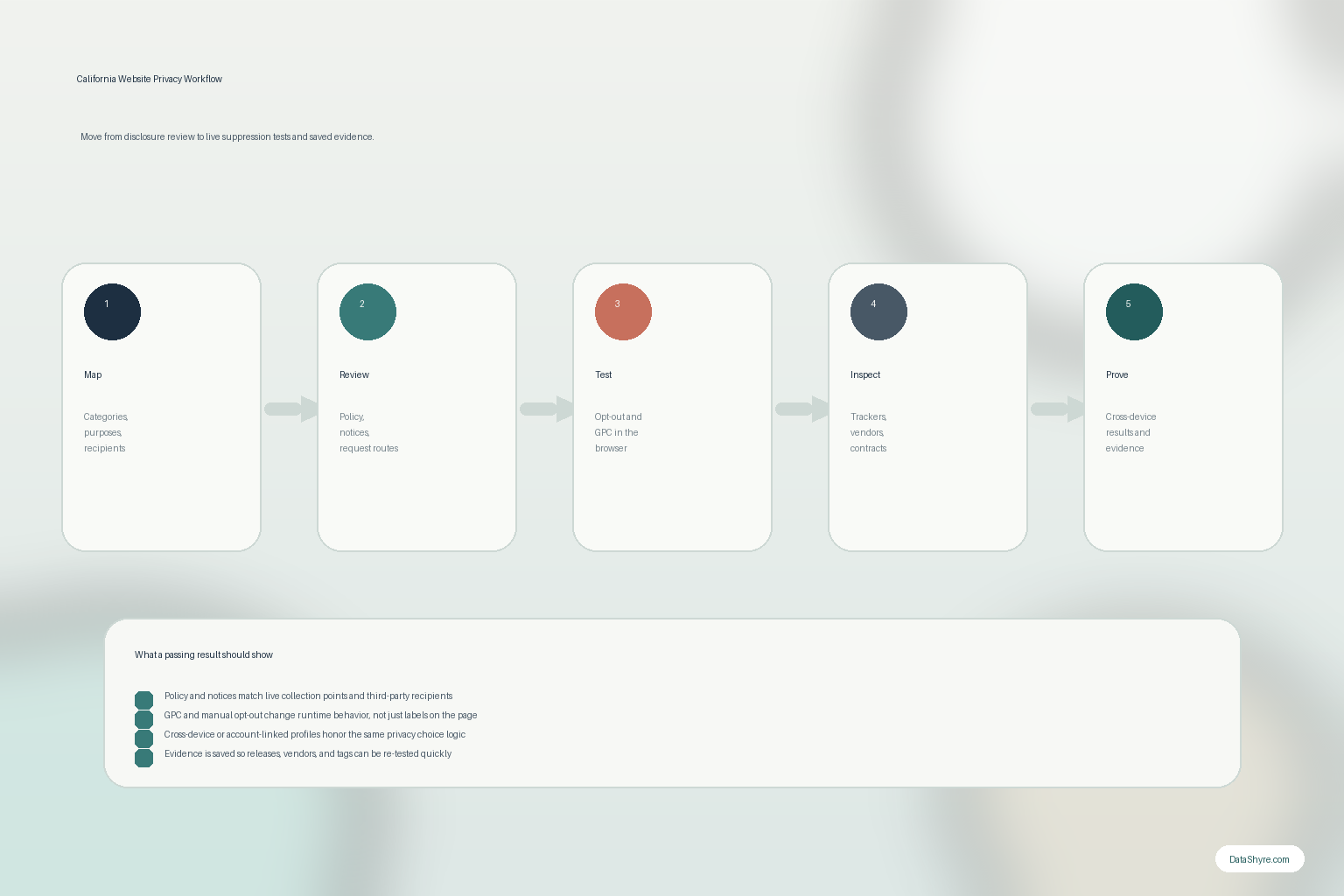
If I were auditing california consumer protection act obligations on a live website this week, I would use this order:
- map the categories, purposes, and recipients of personal information;
- review the privacy policy for required rights, methods, and signal handling;
- compare every collection point against the notice language;
- test opt-out and GPC behavior live in the browser;
- inspect trackers, recipients, and suppression behavior after the request;
- test account-linked and cross-device privacy-choice handling; and
- save evidence and assign refresh owners before the next release.
That workflow catches more truth than a footer review alone.
FAQ
Does california consumer protection act usually mean only the privacy policy?
No. For website teams, the real work usually includes the policy, collection notices, opt-out or privacy-choice controls, tracker behavior, and evidence that the controls actually work.
Is GPC optional if we already have a privacy-choices link?
Not where the law requires honoring a valid opt-out preference signal. California’s official GPC guidance still says covered businesses must honor it as a valid request to stop sale or sharing.
Why do tracker and vendor tests matter so much?
Because California enforcement materials keep focusing on online tracking technology, third-party disclosures, broken opt-outs, and inaccurate disclosures rather than on wording alone.
Bottom line
The useful meaning of california consumer protection act for a website team in 2026 is not write a nicer policy.
It is to make the California privacy stack work end to end:
Seen clearly, california consumer protection act is less about a pop-up and more about whether the site behaves honestly after the visitor makes a choice.
Sources
- California Department of Justice, California Consumer Privacy Act (CCPA): https://oag.ca.gov/privacy/ccpa
- California Department of Justice, Global Privacy Control (GPC): https://oag.ca.gov/privacy/ccpa/gpc
- California Privacy Protection Agency, What General Notices Are Required By The CCPA?: https://cppa.ca.gov/pdf/general_notices.pdf
- California Privacy Protection Agency, Frequently Asked Questions (FAQs): https://cppa.ca.gov/faq.html
- California Department of Justice, CCPA Enforcement Case Examples: https://oag.ca.gov/privacy/ccpa/enforcement
- California Department of Justice, Privacy Enforcement Actions: https://oag.ca.gov/privacy/privacy-enforcement-actions
- California Department of Justice, California Won’t Let It Go: Attorney General Bonta Announces $2.75 Million Settlement with Disney: https://www.oag.ca.gov/news/press-releases/california-wont-let-it-go-attorney-general-bonta-announces-275-million
- California Department of Justice, Attorney General Bonta Announces Largest CCPA Settlement to Date, Secures $1.55 Million from Healthline.com: https://www.oag.ca.gov/news/press-releases/attorney-general-bonta-announces-largest-ccpa-settlement-date-secures-155